A tool from Excelano
ved
The verbose ed.
A drop-in compatible clone of ed, the original Unix line editor, written in pure-stdlib Rust. ved keeps strict ed compatibility — any script written for real ed runs unchanged — but adds friendly error messages, long-form command aliases, and a built-in help reference, so it explains itself instead of answering every mistake with a single ?.
ed, but it talks back
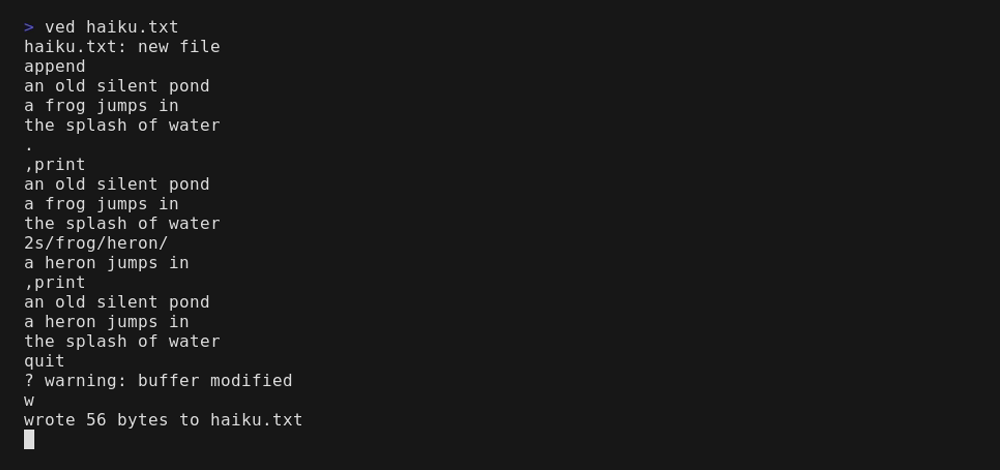
Real ed answers nearly every problem with a single ?. ved keeps the same commands and the same behavior, but tells you what went wrong: ? invalid address, ? unterminated replacement, ? warning: buffer modified. It will not let you quit over unsaved work without a heads-up, and a write reports wrote 56 bytes to haiku.txt rather than a bare byte count.
Every command has a spelled-out alias — append for a, print for p, substitute, delete, quit — and help prints the full reference. None of that breaks compatibility: addresses, regex substitution, global commands (g/v), and the rest behave exactly as ed does, so existing ed scripts run against ved without a change.
It is written in pure-stdlib Rust with no dependencies, and stores nothing on disk but the files you edit.
See it in action
A short session: long-form commands, a substitution, and the friendly messages that real ed leaves out.

New to line editors? The introduction walks through every command, from append to global substitution, and leaves you able to drive real ed on any Unix system.
Install
ved is a single binary for Linux, macOS, and Windows, with nothing to install alongside it.
On Debian or Ubuntu
Add the Excelano apt repository once, so apt upgrade keeps it current:
curl -fsSL https://excelano.com/apt/setup.sh | sudo sh
sudo apt install ved
With Homebrew
On macOS or Linux, so brew upgrade keeps it current:
brew tap excelano/tap
brew trust excelano/tap   # one-time: Homebrew gates third-party taps behind explicit trust
brew install ved
On Windows
With WinGet, so winget upgrade keeps it current:
winget install Excelano.ved
Prebuilt binaries
Tarballs for every platform are on the GitHub releases page. A one-line installer that verifies its checksum and drops ved into ~/.cargo/bin is in the README.
Behind the tool
I built ved because ed's terseness is a feature right up until it isn't — answering a person's every mistake with a lone ? is a poor way to treat them. ved stays strictly compatible but explains itself, because a tool should be kind to the human using it.
That instinct — sweat the small interactions, make the thing pleasant to use — is what I bring to everything I build. If you want software made with that kind of care, that's the work I do.
For technical users
ved is open source under the MIT license, written in pure-stdlib Rust. The full source and the design notes live at github.com/excelano/ved. ved is an independent, clean-room implementation compatible with ed; it is not derived from GNU ed.